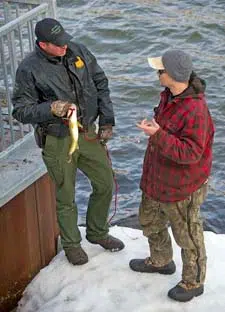
Fishing is big fun – and big business – in Michigan.
Nearly 1.1 million people fish in Michigan each year, keeping cash registers ringing for outdoor retailers and other businesses like restaurants, hotels and gas stations that cater to them. According to a recent report from Michigan United Conservation Clubs (MUCC), fishing contributes $2.3 billion annually to the state’s economic well-being and supports more than 35,000 jobs.
All that fishing translates into big dollars to protect Michigan’s waterways and the fish and wildlife that call them home. In 2018, fishing and hunting licenses generated about $61 million for wildlife and natural resource conservation, with $26.4 million coming just from fishing license sales.
Under state law, that money is entirely dedicated to wildlife management and conservation activities.
“With fishing season getting underway, it’s a good time to remind people that it’s the purchase of fishing and hunting licenses and equipment – not state taxes – that provides most of the funding for conservation projects throughout the state,” said Michigan Wildlife Council (MWC) Chairman Matt Pedigo.
“In fact, license funding was key to the comeback or protection of many beloved species in Michigan, including sturgeon, elk, wild turkey and the Kirtland’s warbler.”
Besides fishing and hunting license sales, equipment purchases also are a key source of funding for conservation projects.
The Federal Aid in Sport Fish Restoration Act, otherwise known as the Dingell-Johnson Act, is a tax on fishing-related equipment, while the Federal Aid in Wildlife Restoration Act, commonly called the Pittman-Robertson Act, assesses a similar levy on sporting arms, handguns, ammunition and archery equipment.
Proceeds from each act are distributed among the states for outdoors conservation and management activities. In 2018, the Michigan Department of Natural Resources received $10.7 million in Dingell-Johnson funding and $24.3 million in Pittman-Robertson funds.
“So when you buy your license for the 2019 fishing season and take the kids shopping for new poles, you’re helping to preserve Michigan’s amazing outdoor heritage,” Pedigo said.
Michigan’s 2019 fishing licenses are good through March 31, 2020, and available online through the Michigan Department of Natural Resources.
In addition, an analysis by the Michigan Wildlife Council based on 2018 DNR data shows:
- Men purchased 80 percent of fishing licenses.
- The highest concentration of fishing license purchases took place in Wayne (6.5 percent), Oakland (5.9 percent), Macomb (4.9 percent), Kent (4.9 percent) and Genesee (3.2 percent) counties.
- Out-of-state purchases of Michigan fishing licenses most frequently came from Wisconsin, Ohio, Indiana, Illinois, Wisconsin and Florida. Out-of-state fishing license purchases accounted for 17 percent of sales.
Pedigo further notes that 87 percent of Michigan’s adult population participates in outdoor recreation activities – not just fishing and hunting but also camping, hiking, canoeing, bird-watching and other pursuits.
“It’s safe to say that anybody who enjoys Michigan’s outdoors benefits when people hunt and fish,” he said, adding that hunting and fishing are also important conservation tools because they help keep wildlife populations in balance with their habitats.
The MWC is a public body established by the Michigan Legislature in 2013. Members are appointed by the governor and subject to the advice and consent of the state Senate. The nine-member, nonpartisan all-volunteer panel was created to direct spending by the Michigan Wildlife Management Public Education Fund, which is dedicated to informing the state’s residents about the benefits of wildlife conservation and management.
To ensure the wildlife populating Michigan’s waters and lands continue to thrive, Michigan uses scientifically based conservation and management methods, Pedigo said. The ultimate aim is to protect, maintain or restore wildlife populations, spur sustainable outdoor recreation use and enjoyment, and support local economies that are based on natural resources.
Michigan’s conservation managers are responsible for a wide variety of activities. Examples range from stocking walleye and managing their habitats near Beaver Island in Northwest Michigan to protecting endangered ospreys from near extinction in Southeast Michigan’s Huron Valley. Conservation staff also measure the impacts of climate change on West Michigan fisheries, oversee construction of new pump stations that help manage wetlands along the Saginaw Bay, monitor the health of deer herds in the northern Lower Peninsula and manage tree harvests in the Upper Peninsula.