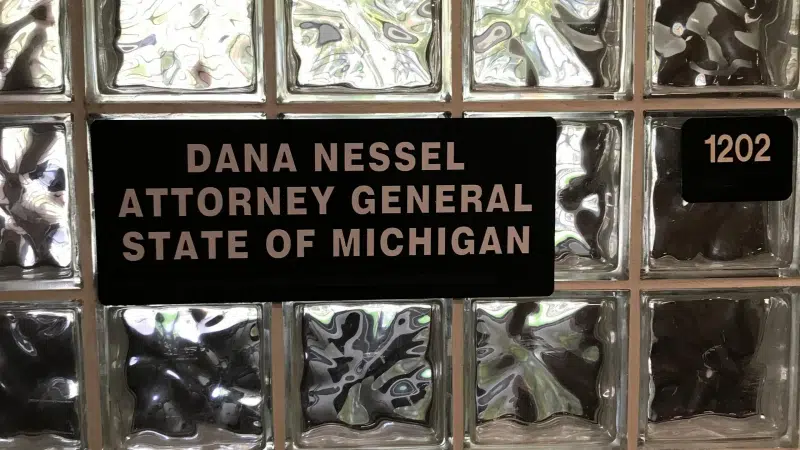
Michigan Attorney General Dana Nessel spoke at the Upper Peninsula State Fair on Tuesday.
She talked about her efforts to cut down on the number of Elder Abuse cases in Michigan…that’s where senior citizens are taken advantage of financially or are otherwise neglected.
Nessel also pledged to work with other state attorneys general to cut down on the number of unwanted robocalls you receive.
 “We are launching a major robocall crackdown initiative later this year,” Nessel said. “We are hoping to become the leading state on eradicating robocalls. They’re not just a nuisance. They’re disruptive. I know people who don’t answer their phones because they don’t know who’s calling.”
Nessel says it’s important that you NOT play the game and just ignore the callers.
“We have a legislative agenda to give our office the tools we need to better crack down on robocalls,” Nessel said. “But before that happens, don’t answer any phone calls from numbers that you don’t recognize. Even if they have your area code. If it’s a legitimate caller, trust me, they’ll leave you a message. If you don’t know the number, you’re being robocalled, like 99 percent of the time. If there’s a pause when you do answer the phone, it probably means that it’s a telemarketer, or a robocaller using something called an auto-dialer. You should hang up immediately.”
Nessel says you can also help to cut down on these calls by filing a complaint with the Consumer Protection Division of her office, and with the Federal Trade Commission. She says Michigan is working with other states in a coordinated effort to cut down on these unwanted calls from telemarketers and others who are trying to scam you out of your personal information and money.”
IN THE BELOW VIDEOS: We aasked Nessel about her efforts to close down the Enbridge Line Five Pipeline that runs under the Straits of Mackinac, and how would the Upper Peninsula get its energy needs filled if the pipeline is shuttered. Nessel said that the pipeline would not be shut down until an energy plan is put into place that would guarantee enough energy for the Upper Peninsula.
She added that the governor’s U.P. Energy Task Force is working on that issue.
Nessel said that the pipeline is “66 years old, and it’s not getting any safer. It is getting more and more dangerous with every passing day.” We also asked her about Enbridge’s plans to build a tunnel to house the pipeline, but Nessel said she doesn’t support that because it would take seven or more years to complete such a tunnel.
After she left the Fairgrounds, Nessel issued this press release on gun control:
Michigan Attorney General Dana Nessel today joined 12 other Attorneys General in urging the Supreme Court to uphold a U.S. Court of Appeals ruling which held that states and localities can impose certain types of firearm regulations when they are substantially related to an important government objective, such as the protection of their residents.
“I am proud to join with my colleagues to preserve the right for state and local governments to implement common-sense gun safety regulations,” said Nessel.
In 2013, the New York State Rifle & Pistol Association and three individual residents of New York City filed a suit challenging the then-existing New York City regulation in the Southern District of New York (SDNY). The suit challenges regulations New York City enacted restricting the transport of firearms held under a premises license, unless the firearms were unloaded, locked, and transported separately from ammunition to firing ranges within the city. The plaintiffs alleged that the city’s former regulation violated the Second Amendment, the dormant Commerce Clause, and the constitutional right to travel. After losing in the SDNY and, subsequently, in the U.S. Court of Appeals for the Second Circuit, the four plaintiffs took their case to the United States Supreme Court.
The Attorneys General in their brief to the U.S. Supreme Court argue that the Second Amendment’s right to bear arms does not prevent states and localities from implementing common-sense gun safety regulations. The plaintiffs’ Commerce Clause and right-to-travel claims should also be rejected, the Attorneys General note in their amicus brief, because states and localities have the right to impose restrictions on firearm transportation.
The Attorneys General also argue that the Supreme Court has made clear that state and local governments throughout the nation may tailor their firearm safety regulations to deal with varying circumstances in each local jurisdiction – a choice New York City made to protect public safety in the largest, densest, and most urbanized major city in the nation.
Nessel joins the Attorneys General of Connecticut, Illinois, Massachusetts, Maryland, New Jersey, New York, Oregon, Pennsylvania, Rhode Island, Vermont, Virginia, and the District of Columbia in filing this brief.
The attorney general also sent a letter on Tuesday defending a potion of the Affordable Care Act:
Michigan Attorney General Dana Nessel today joined a coalition of 22 attorneys general in submitting a comment letter opposing the U.S. Department of Health and Human Services’ (HHS) proposed rule to drastically undermine Section 1557 of the Patient Protection and Affordable Care Act (ACA), which prohibits discrimination in federal healthcare programs, benefits, and services.
Specifically, Section 1557 prohibits discrimination on the basis of race, color, national origin, sex, disability, and age. The proposed rule would roll back anti-discrimination protections for women, LGBTQ individuals, individuals with limited English proficiency, and individuals with disabilities by undermining critical legal protections that guarantee healthcare as a right.
“There is no place for discrimination in our country,” said Nessel. “We cannot stand silent while our federal government attempts to undermine our core values at every turn.”
The ACA prohibits discrimination in federal healthcare—from Medicaid, Medicare, and the healthcare exchanges, to federal healthcare grant programs providing safeguards against discrimination. In fact, the ACA expressly seeks to provide equity in healthcare and prohibits any regulation that creates unreasonable barriers for individuals to obtain healthcare.
The proposed rule contradicts this and other federal civil rights laws by sanctioning discrimination in the healthcare system. It will withdraw key protections, placing patients at greater risk of discrimination on the basis of race, color, national origin, sex, disability, and age.
In today’s letter, the attorneys general emphasize that the rule would undermine the robust anti-discrimination protections set under current law.
This would specifically harm:
- Women: The proposed rule reverses protections against discrimination on the basis of pregnancy, false pregnancy, termination of pregnancy, recovery from childbirth or related conditions. It would lead to the denial of service related to reproductive health, resulting in an increase in unintended pregnancies.
- LGBTQ Individuals: The proposed rule reverses protections against discrimination on the basis of sex stereotyping and gender identity. It would lead LGBTQ individuals, who already experience barriers to receiving medical services, to avoid seeking healthcare services.
- Individuals with Limited English Proficiency: The proposed rule reverses protections for nearly 25 million people in the United States who do not speak English “very well” and may be considered limited English proficient. It would reverse language assistance requirements that ensure individuals are able to communicate with their healthcare service and coverage providers.
- Individuals Living with Disabilities: The proposed rule seeks to reverse requirements set in place to ensure providers make reasonable modifications to policies, practices, or procedures when necessary, to avoid discrimination on the basis of disability.
Attorney General Nessel joined a coalition led by California Attorney General Xavier Becerra and Massachusetts Attorney General Maura Healey in filing the comment letter, alongside the Attorneys General of Connecticut, Delaware, Hawaii, Illinois, Iowa, Kentucky, Maryland, Minnesota, Nevada, New Jersey, New Mexico, New York, North Carolina, Oregon, Pennsylvania, Vermont, Virginia, Washington, and the District of Columbia.
A copy of the letter can be found here.
Also on Tuesday, the Attorney General released this press release on environmental issues:
Michigan Attorney General Dana Nessel today joined 22 other Attorneys General and seven local governments in filing a challenge to the Trump Administration’s Environmental Protection Agency (EPA) over its “Affordable Clean Energy” (ACE) – aka “Dirty Power” – rule.
To combat climate change pollution, the Clean Power Plan was established by the Obama Administration to place limits on the existing fossil-fueled power plants. The Trump Administration replaced the Clean Power Plan with the ACE rule. The new rule – dubbed the “Dirty Power Rule” by opponents – rolls back the limits and will have virtually no impact on power plant emissions, prolonging the nation’s reliance on polluting, expensive coal power plants and obstructing progress toward clean, renewable, and affordable electricity generation.
“My colleagues and I are deeply concerned with the blatant disregard the Trump administration has for science and the imminent threat to all presented by climate change,” said Nessel. “The Clean Power Plan was an important step in the right direction to protect our environment and public health. We will not back down from this fight as our country and the entire world will be negatively affected by Trump’s Dirty Power Rule.”
The Attorneys General will argue that in addition to ignoring the science of climate change, the text of the ACE rule barely mentions climate change, much less recognizes the dire threat it poses to public health, the economy, or the environment, and ultimately disregards requirements of the federal Clean Air Act.
The Clean Air Act empowers the EPA to regulate greenhouse gases and requires limits on air pollutants to be based on the best system of emissions reductions. The Clean Power Plan was based on such a system and required a shift from coal-fueled to less carbon-intensive generation. However, the EPA has ruled out such a system in the Clean Power Plan repeal and promulgation of the Dirty Power rule.
The Attorneys General cite the Regional Greenhouse Gas Initiative (RGGI) as a proven cost-efficient model for reducing power plant emissions of climate change pollution. Power plants in the participating RGGI states (New York, Connecticut, Delaware, Maine, Maryland, Massachusetts, New Jersey, Rhode Island, and Vermont) have cut emissions by more than 50 percent and saw $1.4 billion of net positive economic activity and 14,500 new jobs between 2015 and 2017. This market-based cap-and-trade program maintained reliability of service and held the line on electricity rates.
The Dirty Power Rule, however, prohibits states from participating in cap-and-trade programs as a means of complying with the requirements of the Clean Air Act.
The Attorneys General will also argue the differences in benefits provided by the Clean Power Plan compared to the Trump Dirty Power Rule are substantial, as reflected in the table below using the EPA’s own calculations when it finalized the two rules:
| “Dirty Power” Rule (ACE Rule) |
Clean Power Plan | |
| Pollutant Reductions by 2030 | ||
| CO2 (million tons) | 11 (0.7%) |
415 (16%) |
| SO2 (thousand tons) | 5.7 (0.6%) |
318 (24%) |
| NOx (thousand tons) | 7.1 (0.9%) |
282 (22%) |
| Benefits by 2030 ($ millions)* |
570-1,300 | 34,000-54,000 |
| Costs by 2030 ($ millions)* | 280 | 8,400 |
| Net Benefits by 2030 ($ millions)* |
300-1,000 | 26,000-45,000 |
* 3% Discount Rate; ACE rule in 2016 dollars and Clean Power Plan in 2011 dollars.
Sources: Repeal of the Clean Power Plan; Emission Guidelines for Greenhouse Gas Emissions From Existing Electric Utility Generating Units; Revisions to Emission Guidelines Implementing Regulations, 84 FR 32520, 32583 (July 8, 2019); Carbon Pollution Emission Guidelines for Existing Stationary Sources: Electric Utility Generating Units, 80 FR 64661, 64964 (October 23, 2015).
The International Energy Agency estimates that climate change pollution from the U.S. power sector must be reduced by 74 percent below 2005 levels by 2030 to achieve the goal of limiting worldwide temperature increase to less than 2 degrees Celsius. By the EPA’s own estimates, the Dirty Power Rule falls woefully short of hitting this target with a projected reduction of only 35 percent from 2005 levels. Of that, only roughly one percent is attributable to the impact of the Dirty Power Rule and 34 percent attributable to market factors.
Today’s petition was filed in the US Court of Appeals for the District of Columbia Circuit.
Nessel joins the Attorneys General of California, Colorado, Connecticut, Delaware, Hawaii, Illinois, Maine, Maryland, Massachusetts, Minnesota, New Jersey, New Mexico, New York, North Carolina, Oregon, Pennsylvania, Rhode Island, Vermont, Virginia, Washington, Wisconsin, and the District of Columbia, and the chief legal officers of Boulder, Chicago, Los Angeles, New York City, Philadelphia, and South Miami.