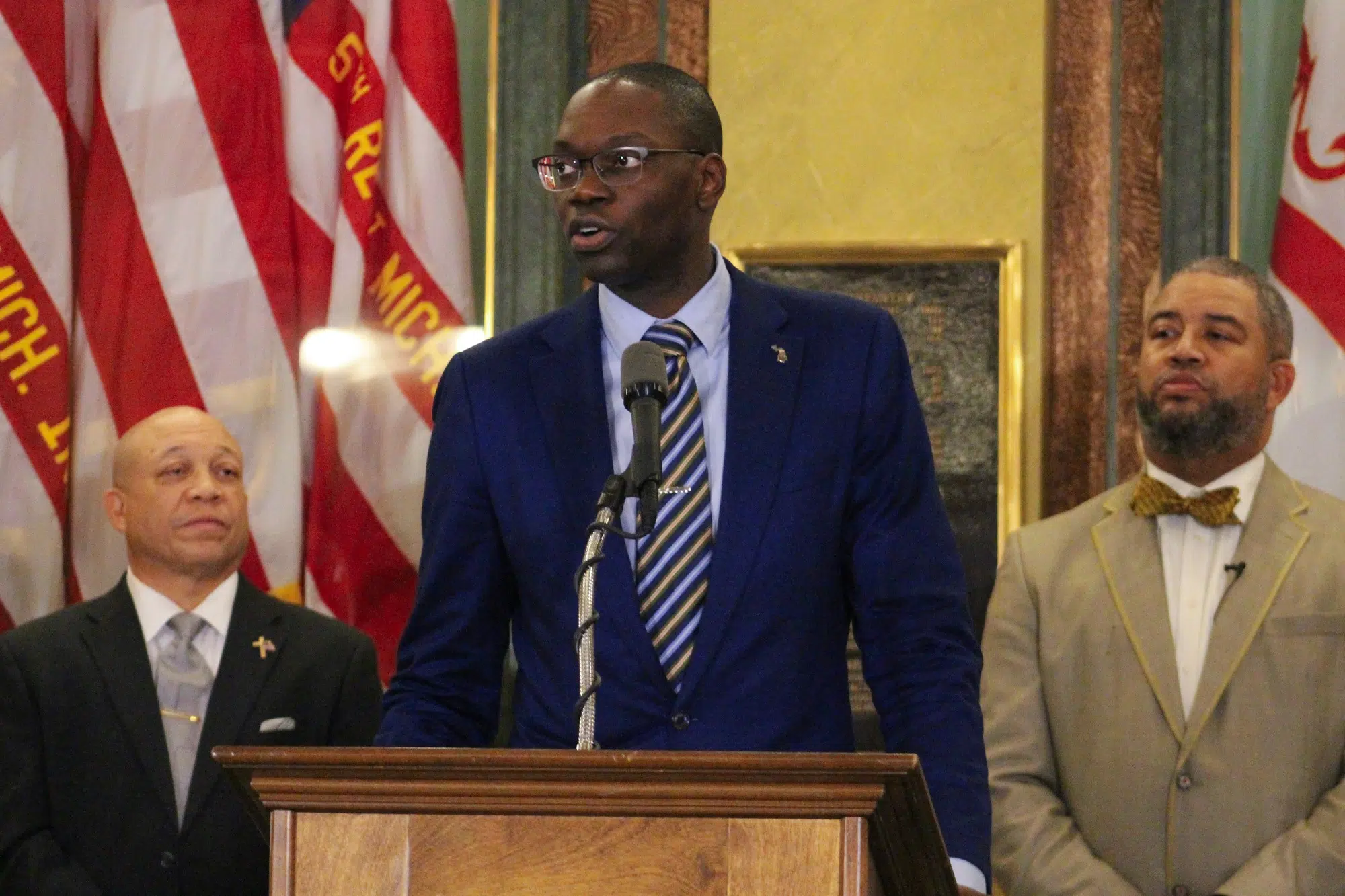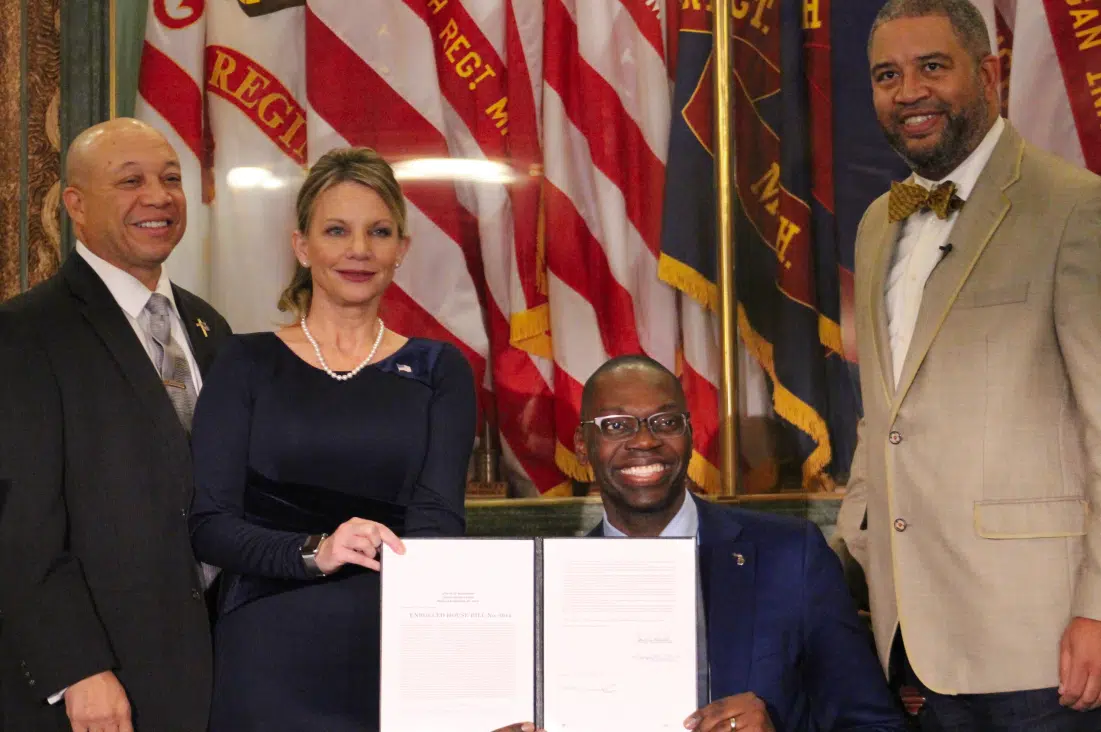
Today Lieutenant Governor Gilchrist, in his role as acting governor, signed House Bill 4044, which passed with strong bipartisan support. With the bill signing, Lt. Governor Gilchrist becomes the first black lieutenant governor to sign a bill into law in our state’s history.
“As the first black lieutenant governor to sign a bill into law, today’s historic action symbolizes the opportunity that exists when we create a space for more participation from a more diverse set of voices and experiences,” Gilchrist said. “Governor Whitmer and I built the most diverse administration in our state’s history because we believe that our practices, policies, and proposals should reflect and enable Michiganders from all backgrounds to be successful.
The signed legislation will reverse the lifelong ban on felons who submit applications for insurance producer licenses by allowing the Department of Insurance and Financial Services to issue those licenses to individuals who have not been convicted of a felony in the last ten years.
While many applicants with prior felonies will be granted an insurance producer license, the new law will still provide exemptions for people with violent-, fiduciary-, or financial-related crimes.
Under current law, the State of Michigan does not grant insurance licenses to individuals with felony convictions. As a result, the State denied 61 applications due to prior felony convictions in 2018. Lt. Governor Gilchrist is serving as the acting governor due to Governor Whitmer’s overseas business trip to Israel to strengthen relationships and build business ties with startups and mobility companies to help Michigan compete for good-paying, high-tech jobs.
House Bill 4044, sponsored by Rep. Michele Hoitenga, will take immediate effect.
Gilchrist also signed House Bills 4209, 4408, 4226, 4959, 4960, and 4961, as well as Senate Bill 320 into law as acting governor.
House Bill 4209 makes it easier for property owners to pay their property taxes by amending the General Property Tax Act to allow the deputy treasurer or another township official to collect taxes. The bill is sponsored by Representative Bradley Slagh (R-Zeeland).
House Bill 4408 provides relief to smaller recreational authorities by amending the Recreational Authorities Act to allow a biennial, rather than annual, audit of authorities that don’t levy taxes or spend more than $100,000 a year. Nevertheless, the Department of Treasury may require an annual audit if there is any indication of accounting irregularities. The bill is sponsored by Representative Aaron Miller (R-Strugis).
House Bill 4226 puts a $250 cap on fees charged for the work to calculate the exact amount individuals must pay to redeem property at foreclosure. The bill is sponsored by Representative Ryan Berman (R-Commerce Township).
House Bill 4959 replaces the requirement that a wholesale liquor retailer demonstrate at least one year residence in Michigan with a new licensing and inspection system that requires wholesalers to maintain at least one licensed warehouse in-state. Under the new system, the Michigan Liquor Control Commission may conduct appropriate inspections, and seize and destroy product that fails inspection. The bill is a part of a set of three bills (HB 4959-4961) referred to as the Distributors Independence Act. The goal of the legislation is to help Michigan local craft beer brands remain competitive amidst larger multi-national breweries. The bill is sponsored by Representative Roger Hauck (R-Beal City).
House Bill 4960 defines “financial records” within the Michigan Liquor Control Code. The bill is sponsored by Representative Rebekah Warren (D-Ann Arbor).
House Bills 4960 and 4961 protect liquor distributors from anti-competitive practices by amending the Michigan Liquor Control Code to prohibit manufacturers (such as breweries, vineyards, and distilleries) from requiring, requesting, or prohibiting certain actions of wholesalers, and prescribing penalties for manufacturers who violated the bill’s provisions. HB 4960 is sponsored by Representative Rebekah Warren (D-Ann Arbor) and HB 4961 is sponsored by Representative Beth Griffin (R-Mattawan).
Senate Bill 320 amends the Michigan Liquor Control Code and removes the requirement that manufacturers or special licensees must obtain a bond in order to obtain a license. The bill is sponsored by Senator Peter MacGregor (R-Rockford).
Gilchrist also signed Senate Bill 174, which states that by December 2024, all egg laying hens in Michigan will be in cage free systems and no non-cage free eggs will be legally allowed to be sold in Michigan. “Michigan is known for having one of the most diverse agricultural and farming industries in the nation,” said Gilchrist. “Signing this bill is the right thing to do. This will ensure that our standards are amongst the strongest in the nation when it comes to protecting animal welfare, while ensuring that egg producers are able to continue to thrive.”
“The package of bills not only address the provisions around egg-laying hens in the state, but it also provides the Michigan Department of Agriculture and Rural Development with key disease emergency response tools which are critical for protecting public and animal health,” said Gary McDowell, MDARD Director. “I appreciate everyone who came to the table to develop policy that moves the state forward, supports Michigan’s farming community and helps protect public health.”Michigan is now the fifth state and the largest egg producing state in the nation to adopt a cage-free requirement, joining California, Washington, Oregon and Rhode Island.
“We’re grateful for the tremendous work of the lieutenant governor’s office in advancing the treatment of egg-laying hens,” said Molly Tamulevich, Michigan State Director of the Humane Society of the United States. “Switching to cage-free production methods will dramatically improve the lives of millions of animals per year.”
“Michigan’s family egg farmers applaud the Whitmer Administration for positioning Michigan as a national leader in cage free egg production. While consumers are demanding more cage-free eggs, it is Michigan’s law which will inspire greater integrity and transparency across the U.S. food system, and allow hard working farm families to continue for future generations,” said Allison Brink, Executive Director at Michigan Allied Poultry Industries.
Senate Bill 174, sponsored by Senator Kevin Daley, was passed with overwhelming support by both chambers of the Michigan Legislature.
This bill will take effect 90 days after enactment.