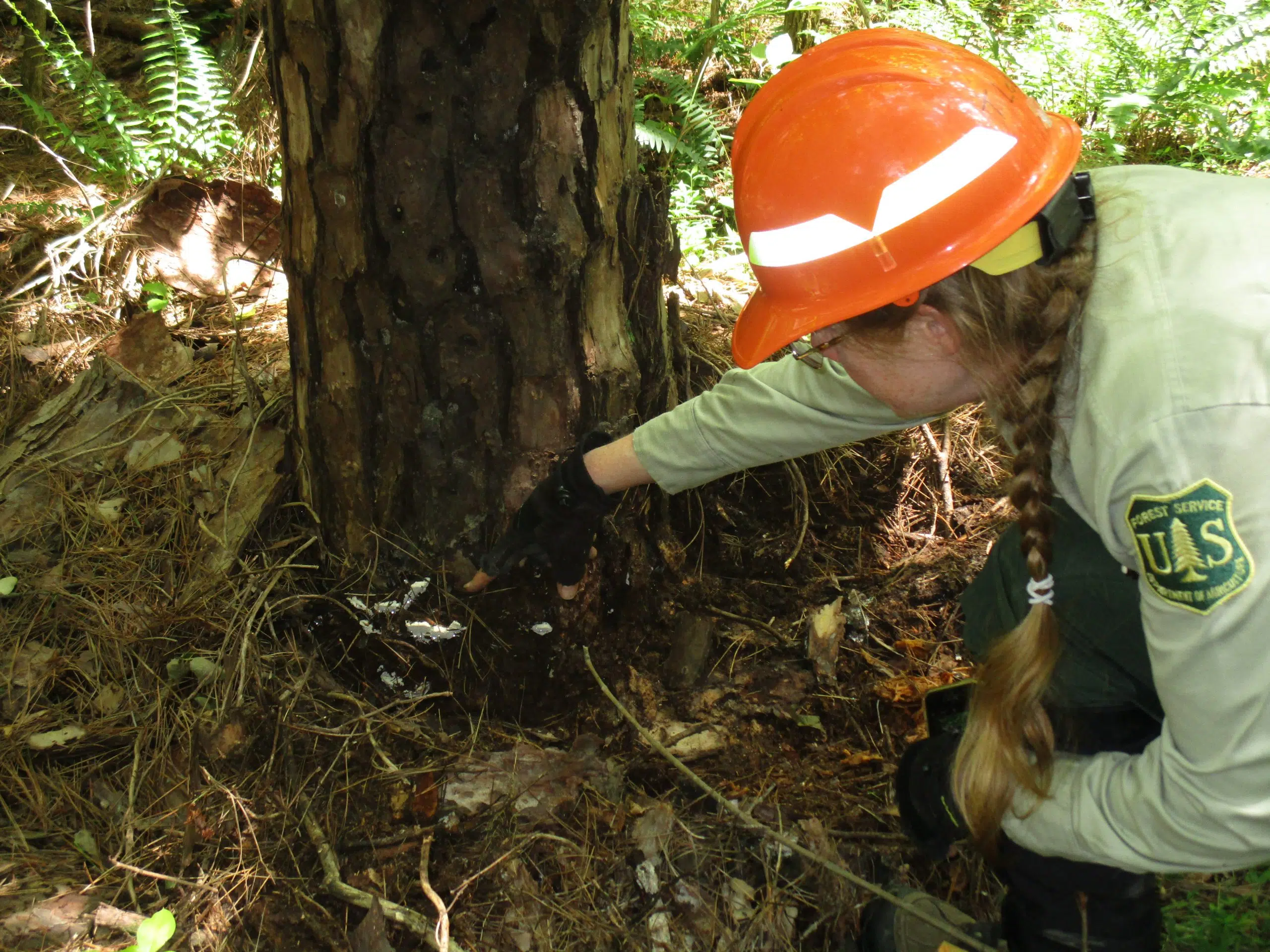
The USDA Forest Service’s State and Private Forestry (S&PF) branch is focused on providing technical forestry assistance to national forests, other federal lands, and tribes, as well as cooperative assistance to states, communities and non-industrial land owners. In November 2019, Eastern Region S&P Forestry’s St. Paul Field Office Forest Health Group, led by Sunny Lucas, provided the Hiawatha National Forest with a summary of the Forest Health Protection surveys conducted by the group during the year.
“We decided to provide this new report to each Forest to see if a summary would be useful for the Forests, — and if it might generate feedback or suggestions that would guide our S&PF work in the future,” said Lucas, a forest pathologist by training.
Specifically, during 2019 the Forest Health Protection Group conducted insect and disease surveys for the Hiawatha National Forest and adjacent areas. In July 2019, annual aerial detection surveys were conducted within the proclamation boundary of Hiawatha. S&PF Unit Aviation Officer Marc Roberts conducted the aerial forest health surveys over federal lands in Michigan to identify insect and disease concerns like spruce budworm defoliation, beech bark disease mortality, forest tent caterpillars, emerald ash borer infestations, and crown decline in sugar maple.
“The data gathered during S&PF aerial surveys of National Forests, National Parks and tribal lands is available to the public via our USDA Forest Service Forest Health webpage, though it does take a few months after the survey to upload the data,” noted Roberts.
Steve Katovich is an USDA Forest Service entomologist with the Eastern Region S&PF Forest Health Protection. As an entomologist, he specializes in the study of insects including forest insect pests. Following up on findings from the July flights, Katovich visited sites on the National Forest in October to evaluate maple decline, stem cankers and abnormal growth on young white pine, and northern white cedar dieback.
So how will the information gathered by Eastern Region S&PF Forest Health Protection specialists be used on the National Forest? USDA Forest Service specialists at Hiawatha National Forest are reviewing the findings, which will inform decisions and implementation of projects on the ground.
“Knowing where insect and disease sites are located on the ground allows us to develop sound projects and complete environmental analysis so we can salvage the trees while they still have value,” said Hiawatha’s Natural Resource Staff Officer, Louise Congdon. A forester by training, Congdon appreciates the importance of current data in managing invasive pests of all kinds.
Jerry Jordan, the Hiawatha’s Forest Silviculturist, is part of the National Forest’s Natural Resource Management Team. Simply put, silviculture is the science of growing and cultivating trees.
“Annual flights are really important because they allow us to compare successive years to see how forest health issues are progressing,” said Jordan. He noted that if Forest staff notice an area of concern, they may contact their S&PF counterparts to request a more targeted survey during the next annual survey.
In addition to its application on the National Forest, the information gathered by the Forest Health Protection group may also be utilized by state, tribal and private landowners within the survey area.
In addition to the flights conducted over National Forest System lands, S&PF funds provide partial funding for the Michigan Department of Natural Resources’ Forest Health Program, which includes aerial surveys over non-federal forested lands in Michigan.
“Insects and pathogens do not stop at ownership boundaries. What impacts the National Forest can easily cross onto private lands and negatively impact a local landowner,” noted Katovich.
In addition to forest health surveys and technical assistance, what else does the S&PF organization do? S&PF is the “outreach arm” of the agency, reaching across the boundaries of national forests to provide cooperative assistance to states, communities and non-industrial private forest landowners. The goal is to provide those landowners and resource managers with technical and financial assistance that helps them sustain the non-federal forests and grasslands they manage, protect communities from wildland fire and restore fire-adapted ecosystems. Cooperative assistance helps ensure that private forests and trees contribute to providing clean water, forest products, wildlife habitat, recreation, and other benefits for present and future generations.
“Considering all aspects of our State and Private Forestry programs, we have a broad impact, working with States, other Federal agencies, tribes, landowners, and other partners to protect, conserve, and manage forests and community trees across the 20 Northeastern and Midwestern States and the District of Columbia,” said Carleen Yocum, Field Representative for S&PF’s St. Paul, Minnesota, Field Office, whose seven-state service area includes the Upper Peninsula of Michigan.
Yocum added that in order to best serve the American public as conservation leaders, S&PF works to be collaborative, focused, adaptive and quick to identify and address emerging forestry issues.
In addition to S&PF’s Forest Health Protection group, their programs include Fire and Aviation Management, Office of Tribal Relations, Cooperative Forestry, Conservation Education and Grey Towers. To learn more about S&PF, visit the USDA Forest Service webpage and the Eastern Region S&PF webpage. To learn more about management of Hiawatha National Forest, visit the forest’s webpage or contact our local offices.