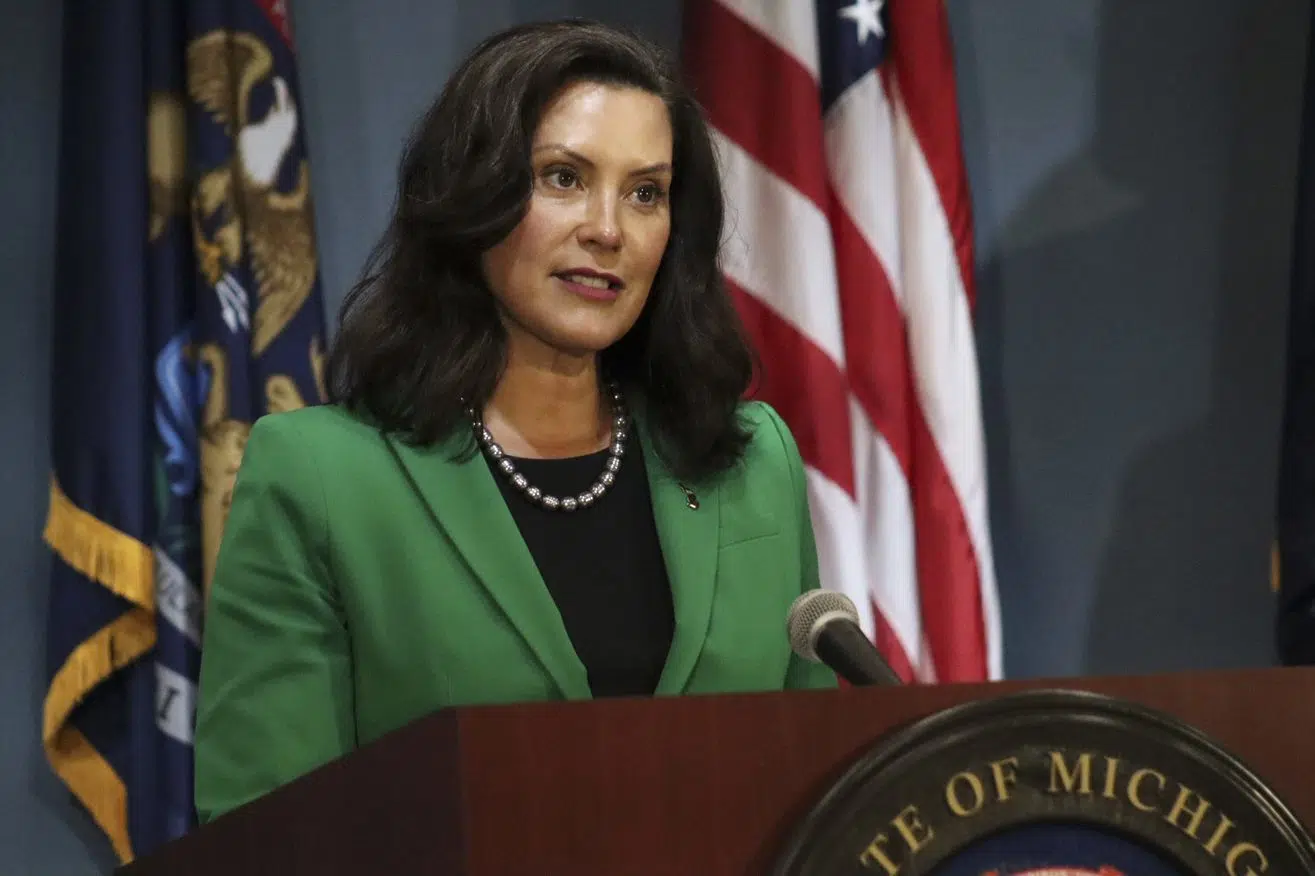
The Michigan Supreme Court on Friday unanimously said that Governor Gretchen Whitmer’s attempt to continue a state of emergency after April 30, 2020 without legislative approval under a 1976 law was illegal.
Additionally, in a 4-3 decision, the Court ruled that the Emergency Powers of Governor Act of 1945, which Whitmer argued allowed her to maintain unilateral control for an indefinite period, is unconstitutional.
Therefore, all executive orders issued after April 30 are null and void, pending an almost certain rehearing request from the governor and other state officials.
Whitmer late Friday blasted the decision that said her use of executive orders to battle the coronavirus was unconstitutional. She said that her orders, including the mask mandate, are still in effect for at least 21 days, and she vowed to use other means after that to continue her orders.
She did not say what those tools were in Friday night’s statement, but could involve rules from the Michigan Department of Health and Human Services, as well as from local health departments.
The Supreme Court decision striking down her orders came just hours after the governor had announced that the Upper Peninsula would go back to Phase Four of her response plan on Oct. 9. The U.P. had been in Phase Five for three months. Now, that order, and all of her orders and restructions, are in doubt.
You can read the Supreme Court decision here.
Whitmer was not happy.
“Today’s Supreme Court ruling, handed down by a narrow majority of Republican justices, is deeply disappointing, and I vehemently disagree with the court’s interpretation of the Michigan Constitution,” Whitmer said. “Right now, every state and the federal government have some form of declared emergency. With this decision, Michigan will become the sole outlier at a time when the Upper Peninsula is experiencing rates of COVID infection not seen in our state since April.”
“Since the beginning of this crisis, I have done everything in my power to protect our seniors, small businesses, and first responders from the worst public health emergency in over a century,” Whitmer added. “Thanks to the hard work of millions of Michiganders who sacrificed and did the right thing, we have saved thousands of lives and laid the foundation for a strong economic recovery. But COVID-19 still poses a clear and present danger to the people of Michigan, our economy, and our way of life.”
The case was originally filed in May by the Mackinac Center Legal Foundation, in conjunction with the Grand Rapids-based Miller Johnson law firm.
“The Court has restored the voices of 10 million Michiganders by reaffirming the constitutional protections of checks and balances afforded through the separation of powers,” said Patrick Wright, vice president for legal affairs at the Mackinac Center and director of the Mackinac Center Legal Foundation. “This important decision was long in the making, but now future COVID responses will have the benefit of including the people’s representatives through the legislative process. As our state continues to face the challenges that come with COVID-19, all of the people of Michigan will have a voice in the decisions that will impact our state in the years to come.”
Whitmer says her orders are still needed to fight the virus. She has issued nearly 200 executive orders since the crisis began in March.
“This virus has now killed more Michiganders than World War I. It is a novel virus for which there is no cure, and which has infected the President of the United States, members of the United States Congress, and Legislators across our state,” Whitmer ssaid. “: This virus continues to take the lives of Americans every single day, and without a cure or approved vaccine, that will continue for the foreseeable future.”
The original case was filed on behalf of three medical practitioners who were unable to provide necessary care and a patient who was unable to receive care under the governor’s emergency executive orders.
Grand Health Partners, Wellston Medical Center and Primary Health Services were among the health care facilities across Michigan initially prevented from performing elective procedures like endoscopies and surgeries. Their patients experienced heart attacks and depression. Jeffery Gullick is a patient who faced excruciating pain after being forced to postpone a knee surgery.
“We’re ecstatic that the Court has ruled in our favor,” said Dr. Randall Baker, a plaintiff in the case. “We’re thankful for the rule of justice and that we can put patients first, like we’ve been trained and desire to do. It’s a great day for the people of Michigan.”
Whitmer, though, insisted that her orders are still in effect, and are the law of the land.
“It is important to note that this ruling does not take effect for at least 21 days, and until then, my emergency declaration and orders retain the force of law,” Whitmer said. “Furthermore, after 21 days, many of the responsive measures I have put in place to control the spread of the virus will continue under alternative sources of authority that were not at issue in today’s ruling.”
The justices unanimously held that Whitmer acted illegally by declaring a state of emergency under the Emergency Management Act of 1976. The law clearly requires the Legislature to approve extending emergencies after 28 days, and Gov. Whitmer illegally attempted to bypass that requirement.
The majority of four justices, Justices Markman, Zahra, Clement, and Viviano, then held that the EPGA of 1945 is unconstitutional because it illegally gives the governor overly broad legislative powers. The majority concluded that the EPGA lacked sufficient standards to limit the governor’s authority and maintain a clear separation of powers.
Chief Justice McCormick and Justices Bernstein and Cavanagh dissented from striking down the EPGA as unconstitutional, arguing that standards in the statute limit the governor’s power. The majority held, though, that these standards, requiring executive orders to be “reasonable” and “necessary,” fail to “[constrain the governor’s] actions in any meaningful way.”
Whitmer pointed to the rising number of cases in the U.P. as proof she needs to continue to issue orders. She said that she will continue to use whatever tools she has available to continue restrictions designed to savce lives.
“I know this is hard. We all want this crisis to be over, and we all want life to return to normal as soon as possible,” Whitmer said. “But the only way we will get through this is by pulling together as Americans and working as one nation to defeat this virus. That means wearing a mask, washing your hands frequently, and maintaining six feet of physical distancing. Michiganders have grit, and there is no challenge we can’t meet.”
“I want the people of Michigan to know that no matter what happens, I will never stop fighting to keep you and your families safe from this deadly virus.”
The Mackinac Center says that moving forward, Whitmer will need to work with the Legislature through the normal legislative process to issue policies related to COVID-19.
“This victory restores the people’s constitutional right to meaningful representation,” said Joseph Lehman, president of the Mackinac Center. “The governor does not have unilateral power for an unlimited time. Now she must include the Legislature in confronting the pandemic. It’s possible to protect lives without depriving the people of fundamental constitutional rights.”






















Comments