The state of Michigan today announced that 32 projects will share $3.6 million in funding through the Michigan Invasive Species Grant Program for efforts that address the prevention, detection, eradication and control of aquatic (water-based) and terrestrial (land-based) invasive species.
To date, over $40 million has been awarded to support 301 projects undertaken by units of government, nonprofit organizations and institutions. The program – cooperatively implemented by the Michigan departments of Agriculture and Rural Development; Environment, Great Lakes, and Energy; and Natural Resources – has four key objectives:
Preventing the introduction of new invasive species.
Strengthening the statewide invasive species early detection and response network.
Limiting the spread of recently confirmed invasive species.
Managing and controlling widespread, established invasive species.
UPPER PENINSULA PROJECTS APPROVED:
Upper Peninsula Resource Conservation and Development Council. Enhancing surveillance for HWA across Michigan’s Upper Peninsula. The UP RC&D Council will utilize the partnerships of three UP CISMAs to enhance and expand EDRR efforts for the Watch List species Hemlock Woolly Adelgid, through targeted outreach, eDNA trap deployment, and detection survey on public and private lands across four counties in Michigan’ Upper Peninsula: Menominee, Delta, Schoolcraft, Mackinac counties. $192,300
Marquette County Conservation District. Support for Essential Functions of L2L CISMA. This funding will support the internal and essential functions of Lake to Lake (L2L) CISMA including Coordinator support, outreach and education, and essential survey and treatment efforts. Alger, Delta, Marquette, Schoolcraft counties. $95,900
Dickinson Conservation District. Sustain Landowner Stewardship Initiatives while Maintaining Key CISMA Programming. This project will provide key operational funding for WRISC & will allow the CISMA to focus in on primary programs, including education & outreach, management of priority invasives, & building partnerships. Dickinson, Menominee Counties. $70,000
Iron Baraga Conservation District. WePIC CWMA: Public Partnership For Invasives Impacting Water Resources. WePIC: Tri-County Prevention, Identification and Control of Invasive Species Targeting Water Resources within the Western Peninsula Invasive Coalition (WePIC CWMA) service area. Iron, Gogebic, Ontonagon counties. $70,000
Chippewa Luce Mackinac Conservation District. Three Shores CISMA 2025 Core Funding The “Three Shores CISMA 2025 Core Funding” will carry out the objectives of the Three Shores CISMA Strategic Plan by providing a network of invasive species leadership, expertise, professional management, and outreach to Michigan’s Eastern Upper Peninsula. Chippewa, Luce, Mackinac counties. $94,900
Michigan Tech University. Building KISMA community IS awareness through outreach to diverse audiences. The Keweenaw Invasive Species Management Area (KISMA) is expanding services with multi-source funding that will provide opportunities for terrestrial and aquatic invasive species outreach, surveying, treatment, and monitoring across Baraga, Houghton, and Keweenaw Counties. $70,000
Grant funds will support several early detection and response efforts for several watch list invasive species – those that pose an immediate or potential threat to Michigan’s economy, environment or human health and either have never been confirmed in the wild in Michigan or have a limited known distribution:
Surveying and treating hemlock woolly adelgid on the northern edge of the infestation in Antrim, Charlevoix and Emmet counties along the Lake Michigan shoreline.
Conducting surveys for hemlock woolly adelgid along the southern coastal areas of the Upper Peninsula.
Using environmental DNA monitoring to detect hemlock woolly adelgid in high-priority areas and to better identify and predict the insect’s spread.
Conducting survey and treatment of mile-a-minute weed infestations in Calhoun County.
Tracking the progress of beech leaf disease symptoms to determine survival rates and possible resistant strains of American beech.
Funding also will support efforts to prevent the spread of invasive species:
Improving the effectiveness of Eurasian watermilfoil chemical treatments by genetically screening milfoil populations to determine their response to commonly used and emerging herbicides.
Building a network to enhance information about, prevention and monitoring of, and response to aquatic invasive species in northern Michigan lakes.
Sustaining the Go Beyond Beauty program, which raises awareness of high-priority ornamental invasive species in trade, as it expands regional hubs in several cooperative invasive species management areas across the state.
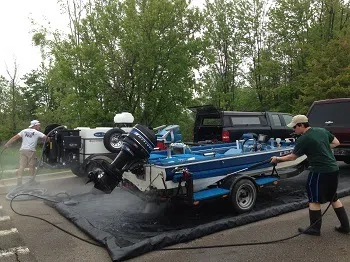
Continuing support for the Clean Boats, Clean Waters program, including its grant program and mobile boat wash crew, to educate boaters and anglers on invasive species prevention actions they can take.
Supporting continued public reporting of invasive species detections and a growing library of identification resources and training opportunities through the Midwest Invasive Species Information Network, housed at Michigan State University.
This year’s grants also support 22 regional cooperative invasive species management areas, the network of partnership organizations working to manage and control invasive species, actively serving all 83 counties in the state.
Each CISMA is eligible for $70,000 in annual support to provide education and technical assistance to landowners and up to $40,000 for tailored outreach and survey and treatment of high-priority invasive species. Grants to CISMAs represent nearly $1.8 million in this cycle ‒ approximately half of all MISGP awards.
The program was initiated in 2014, when the state Legislature designated annual funding to address invasive species, with $3.6 million earmarked for grants. This support substantially enhanced Michigan’s Invasive Species Program for aquatic organisms, supported a formal program for terrestrial species and initiated the Michigan Invasive Species Grant Program.
More than 678,000 acres of land and water have been surveyed for invasive species.
More than 56,000 acres have been treated for invasive terrestrial and aquatic plants.
Through direct contact, including face-to-face interactions at boat washes, workshops, trainings and other events, 486,000 people have been reached with information about invasive species.
An additional 49 million contacts were achieved through grantees’ indirect outreach efforts, including mail, newspapers, social media and handouts.
The program began accepting grant applications for this funding cycle in September 2024. A total of 52 applications were received, requesting approximately $8.9 million in support.
The full list of grant recipients, project descriptions and award amounts is available on the Michigan Invasive Species Grant Program website at Michigan.gov/MISGP.
Michigan’s Invasive Species Program is cooperatively implemented by the Michigan departments of Agriculture and Rural Development; Environment, Great Lakes and Energy; and Natural Resources.





















Comments