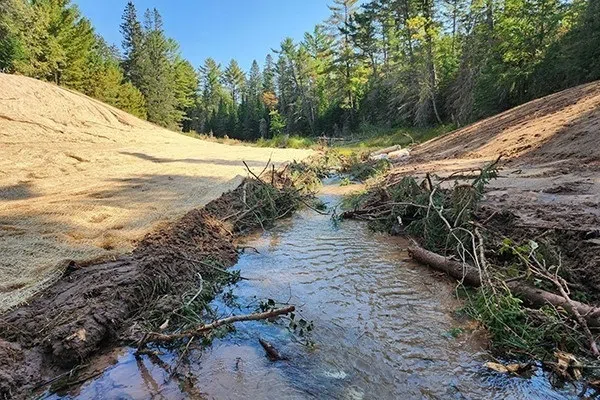
The Michigan D-N-R says it is halfway through a 5-million dollar project to remove 27 stream barriers across the state, and have already reconnected more than 140 miles of streams.
Two of those projects are in the eastern Upper Peninsula, using federal money to restore aquatic ecosystems and cut down on possible flooding. In the U.P., the removal of the Spring Creek Trout P
ond Dam in Luce County is done, and the removal of the McAlpine Trout Pond Dam in Mackinac County is expected to be done next month. Another 13 projects are set for 2026, including the Carr Creek Fish Barrier in Delta County and the Big Trout Lake Fish Barrier in Marquette County.
“Funding from this partnership helped us restore connectivity to two major fisheries (Five Mile and Wycamp creeks) for LTBB citizens,” said Samuel Day, Great Lakes fisheries research specialist at Little Traverse Bay Bands of Odawa Indians. “The new crossings make it easier for native fish like suckers to migrate from Lake Michigan to their spawning grounds and will help sustain these fisheries for generations to come.”
An additional four projects are remnants of the state’s fish hatchery and production program. The structures are no longer needed for contemporary production, and their removal is necessary to restore stream banks and also to improve stream connectivity for fish. These project locations include Dana Lake Pike Marsh Dam (Delta County), Thompson Creek Blocking Weir (Schoolcraft County), Almena Hatchery Dams 1–5 and a diversion dam (Van Buren County) and Rapid River Pike Marsh structure (Delta County).
“The Superior Watershed Partnership is pleased to be working with the Michigan DNR to remove three obsolete dams in the Upper Peninsula,” said the partnership’s senior planner, Geraldine Grant, referring to Big Trout Lake Fish Barrier, Carr Creek Fish Barrier and Dana Lake Pike Marsh dams. “Removal of these dams will benefit recreational users, address concerns with aging infrastructure, eliminate public safety risks, and improve river connectivity, aquatic organism passage and climate resiliency.”
Upon completion, nearly 200 upstream miles of Michigan rivers and streams will be reconnected, benefiting at-risk species like the eastern massasauga rattlesnake, pickerel frog, and fluted shell and elktoe freshwater mussels, along with countless other aquatic species.
All of the work for the America’s Ecosystem Restoration Initiative project is expected to be completed by January 2027.




















Comments