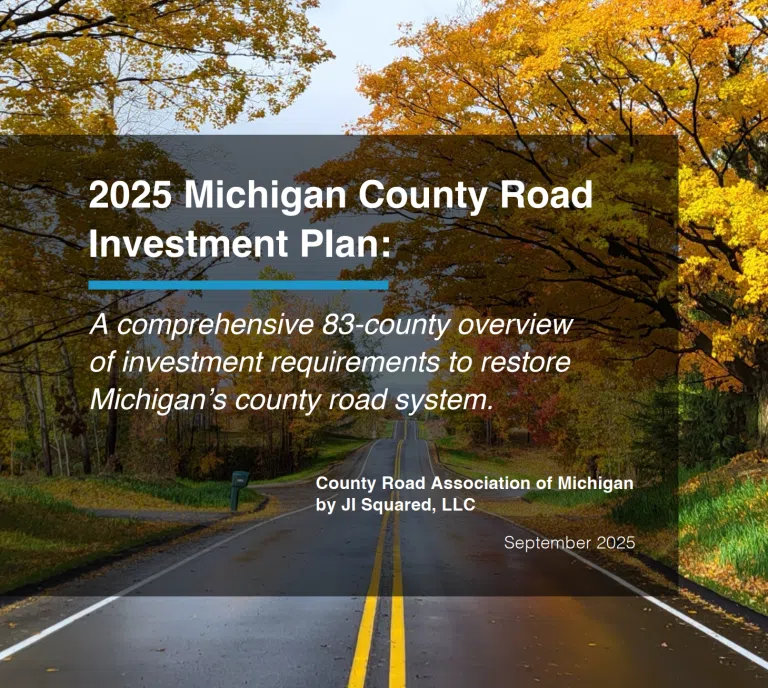
Michigan’s 83 county road agencies face a local bridge funding crisis and growing overall funding gap, according to findings in the County Road Association (CRA) of Michigan’s 2025 County Road Investment Plan released on Tuesday.
This is CRA’s fourth biennial Investment Plan, which collects county data to develop costs to maintain county transportation assets. County road agencies have 75% of Michigan centerline miles and 52% of the state’s bridges. The Plan illustrates the importance of the Legislature and governor approving a budget with their called-for $3 billion (B) of additional road funding.
The document is posted here: https://micountyroads.org/wp-content/uploads/2025-County-Road-Investment-Plan-FINAL-091125.pdf
This year’s report documents a concerning shortfall in money to repair, preserve and replace Michigan’s 5,868 county bridges. Bridge costs have surged 32% since CRA’s 2023 County Road Investment Plan. At the same time, counties have 72 bridges that are closed, 77 bridges rated in critical condition and another 255 bridges in serious condition, according to Michigan Department of Transportation (MDOT) data from earlier this month.
In 2023, the Plan’s key takeaway was a huge growth in needs on paved nonfederal aid roads, or local roads. While that’s still the largest need by far, the fastest increasing need in 2025 are bridges.
CRA leaders say their latest report is another metric that shows Michigan’s county road and bridge network is in desperate need of additional funds and called on the governor and Legislature to approve a new, sustainable, adequate road funding plan now.
“Bridges are the most expensive segment of a road. Our counties and MDOT report that our bridges are aging rapidly and are a key indicator that our transportation system needs more funds,” said Denise Donohue, CRA CEO. “This is not a question of shuffling money around from urban to rural or vice-versa or economizing our way out of a sadly deteriorating road network. Identifying and committing to long-term road funding is the answer.”
The 2025 County Road Investment Plan identifies the necessary level of investment into the county road and bridge system to meet modest improvement goals as $4.5 B annually, up from $4.1 B in the 2023 Investment Plan. When current road funds are subtracted, the remaining need is $2.4 B. That figure is up just 1% in the last two years – while the bridge cost escalated by nearly one-third in the same timeframe, Donohue said.
The run-up in bridge costs comes from multiple factors including safety and environmental regulations that have changed significantly in the 50 years since many of these bridges were built, said Ed Noyola, CRA chief deputy and legislative director.
“In the last decade, counties have turned 153 culverts into bridges to meet modern engineering standards and environmental concerns about increased water flow from upstream development,” Noyola said. “Also, safety standards dictate that any new bridge deck will be 20% wider than a bridge built 50 years ago.”
“Material supply costs and highly specific bridge engineers also contribute to the high costs to replace county bridges, which typically have a 50-year life span,” Noyola said. “We’re not saying that bridges are unsafe. But we are saying that decades of deferred work on Michigan bridges have brought us to the brink of obsolete structures and big replacement costs to meet modern standards and industry needs.”
Besides replacement cost for county bridges, which was amortized across 50 years in the Investment Plan, MDOT has identified a current $1 B backlog in critical, serious and closed local bridges. This year about $400 million in funding applications to Michigan’s Local Bridge Program were received, chasing $50 M of available local bridge funds. More bridges would apply to the program, but counties are limited to three applications per year due to the comparatively sparse dollars.
“Local bridge funding just doesn’t match the need, and every year the backlog grows along with the price tag,” said Jerry Byrne, CRA president and managing director of the Kent County Road Commission. “Two years ago, we had zero bridges posted with weight restrictions. Today, we’re up to 11. That means more trucks, traveling more miles, driving up costs for both businesses and consumers. Instead of making the critical investments needed, we’re deferring work, and that’s taking a toll on residents, the local economy and our ability to plan for the future.”
The 2025 County Road Investment Plan sets a statewide goal of achieving 90% good/fair ratings on federal aid-eligible county roads, aligning with the MDOT target. The county goal for local roads (not eligible for federal aid) is 60% good/fair against a current benchmark of 46% good/fair.
“We have a long road back to good roads,” Donohue said. “County road agencies aren’t asking for autobahns and high-tech bridges, they’re simply trying to meet their statutory responsibility to serve their communities with a safe and efficient county road and bridge network.”
“The ability to restore our roads and bridges is foundational to a prosperous Michigan that saves our vehicle drivers money in repairs and sets our state up for a more prosperous future,” Donohue said. “We need our Lansing leaders to act now.”
The 83 members of the County Road Association of Michigan represent the unified voice for a safe and efficient county transportation infrastructure system in Michigan, including appropriate stewardship of the public’s right-of-way in rural and urban Michigan. County road agencies maintain 75% of Michigan road miles and more than half of its bridges.





















Comments