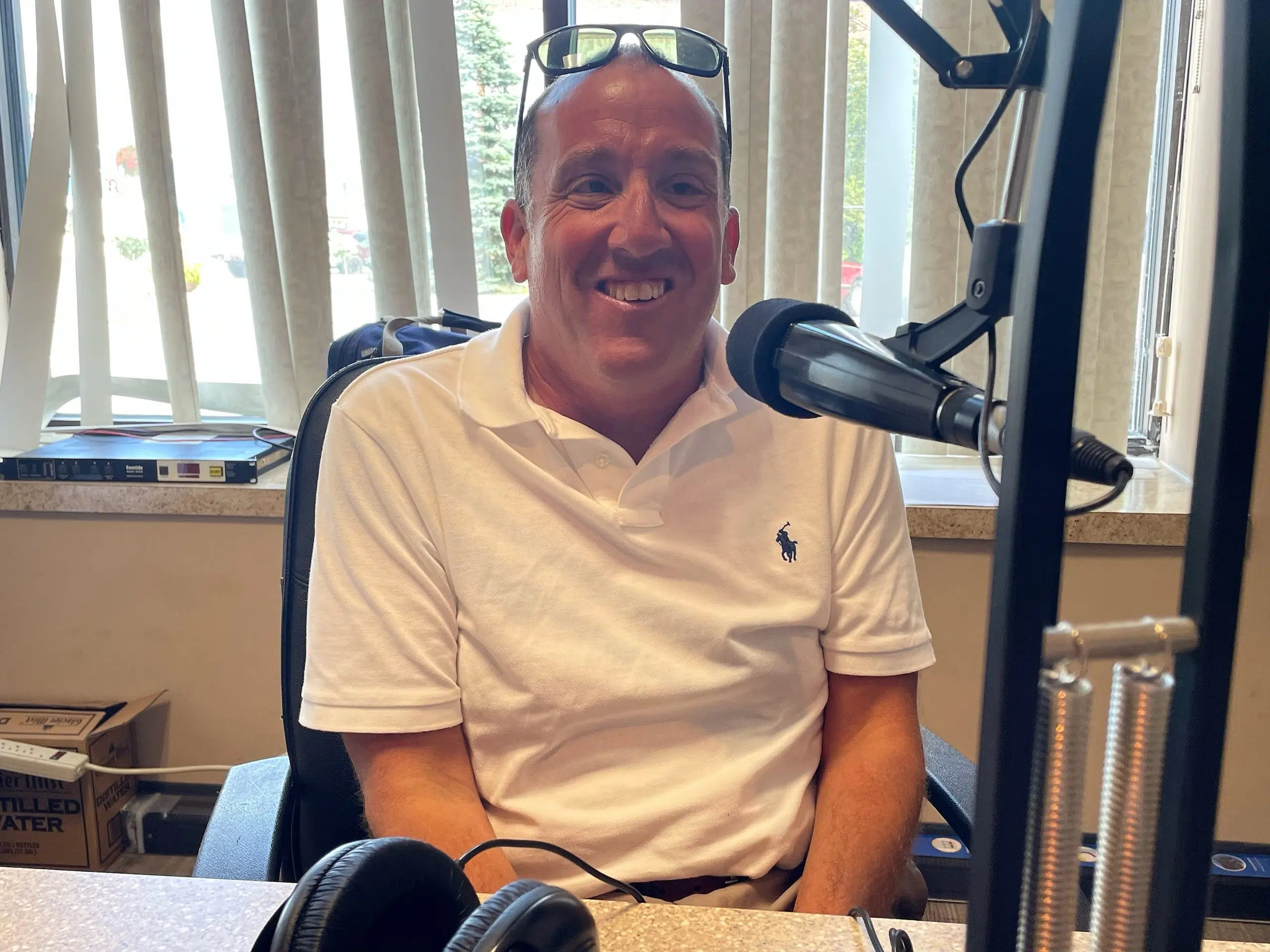
CLICK TO LISTEN TO JACK HALL’S INTERVIEW WITH JUSTICE BERNSTEIN
Michigan Supreme Court Justice Richard Bernstein returned to what he liked to do before the COVID-19 pandemic: visit the Upper Peninsula. Bernstein made stops in Marquette on Sunday and Escanaba on Monday, meeting with local judges and attorneys, but also just walking around the area and saying “hello” to new people.
“I always tried to come up here three times a year,” Bermstein said. “I love the Upper Peninsula. I feel just fabulous up here. The people are so friendly. You could not find kinder, nicer people. As a blind person, I mean, people say hi to you when you go out for walks! It is just a fantastic place to be. “
Bernstein, who was born blind, has been on the Michigan Supreme Court since 2015. He comes from the well-known Bernstein family of attorneys in Detroit, was supported by the Democratic Party. The 47-year-old Bernstein is up for re-election for another eight-year term this November.
Bernstein joined a unanimous decision which ruled that the emergency powers that Gov. Gretchen Whitmer (D-Mich.) were using under a 1976 law to close schools, businesses, and to limit gatherings, was unconstitutional. She was only allowed to issue such orders for 30 days without extensions from the legislature, that ruling said.
But in a separate ruling, when the then-Republican controlled Supreme Court voted 4-3 to strike down Whitmer’s orders under a 1945 law, Bernstein voted with the governor.
On Monday, while visiting the RRN newsroom, Bernstein said this:
“When you allow for government the right to make these arching decisions, that basically effect individual liberties and individual rights, the problem is, most times, the government doesn’t know what the hell it is doing,” Bernstein said.
Bernstein says that as a blind person, he was harmed by Whitmer’s rules, in particular, when services like Uber weren’t allowed to operate.
“It was impossible for me to get around,” he said. “It was impossible for me to get food. And there were a number of disabled people who basically took their own lives. The isolation that so many people with disabilities felt, was so intense, that I lost some friends. Not from COVID. They killed themselves because they couldn’t handle that isolation. They couldn’t handle the despair.”
Bernstein says he believes in individual freedoms in these cases.
“People need to be able to assess their own risks,” Bernstein said.
He also blasted the mask mandates, saying that they harmed people who are hearing-impaired because they rely on reading lips as a mode of communication.
“I would hear these things like see-through masks,” Bernstein scoffed. “Well, that doesn’t work! At the end of the day, if somebody wants to wear a mask, they should feel free to wear a mask. But you can’t really require folks to do those kind of things.”
After her powers were stripped, Whitmer relied on the Michigan Department of Health and Human Services to issue similar pandemic orders. Bernstein says that he, and Justice David Viviano, insisted that the Supreme Court hear a case on whether the health department has that power. This is based on a northern Michigan restaurant owner who refused to comply with closures orders and were given big fines. Bernstein says that he can’t comment on the merits of that case, but is excited that this case will be heard before the Supreme Court this term, rather than go through a number of other courts first.
“This case will determine once and for all the state’s power to regulate behavior during a quote-on-quote emergency,” Bernstein said. “Does the state have the power to impose restrictions on businesses, on people, on individuals.”
Bernstein says the hotly-contested 1931 law that bans most abortions in Michigan will also come before the Supreme Court at some point, although not as quickly as Whitmer has been requesting during multiple court filings since the U.S. Supreme Court overturned the Roe v Wade decision.
“There are structures that the court as to operate in, which is why we are an independent branch of government,” Bernstein said. “The question that the court will eventually have to answer is: are there rights that exist within the state constitution? Are there rights in the Michigan Constitution that do not exist in the federal constitution?”
He says there are two cases: one brought by the governor which is pending at the Supreme Court, and another, brought by Planned Parenthood, Inc., that will have hearings in the Oakland County Circuit Court later this month.
“Ultimately,” Bernstein said. “This will be decided by the Michigan Supreme Court.”




















Comments