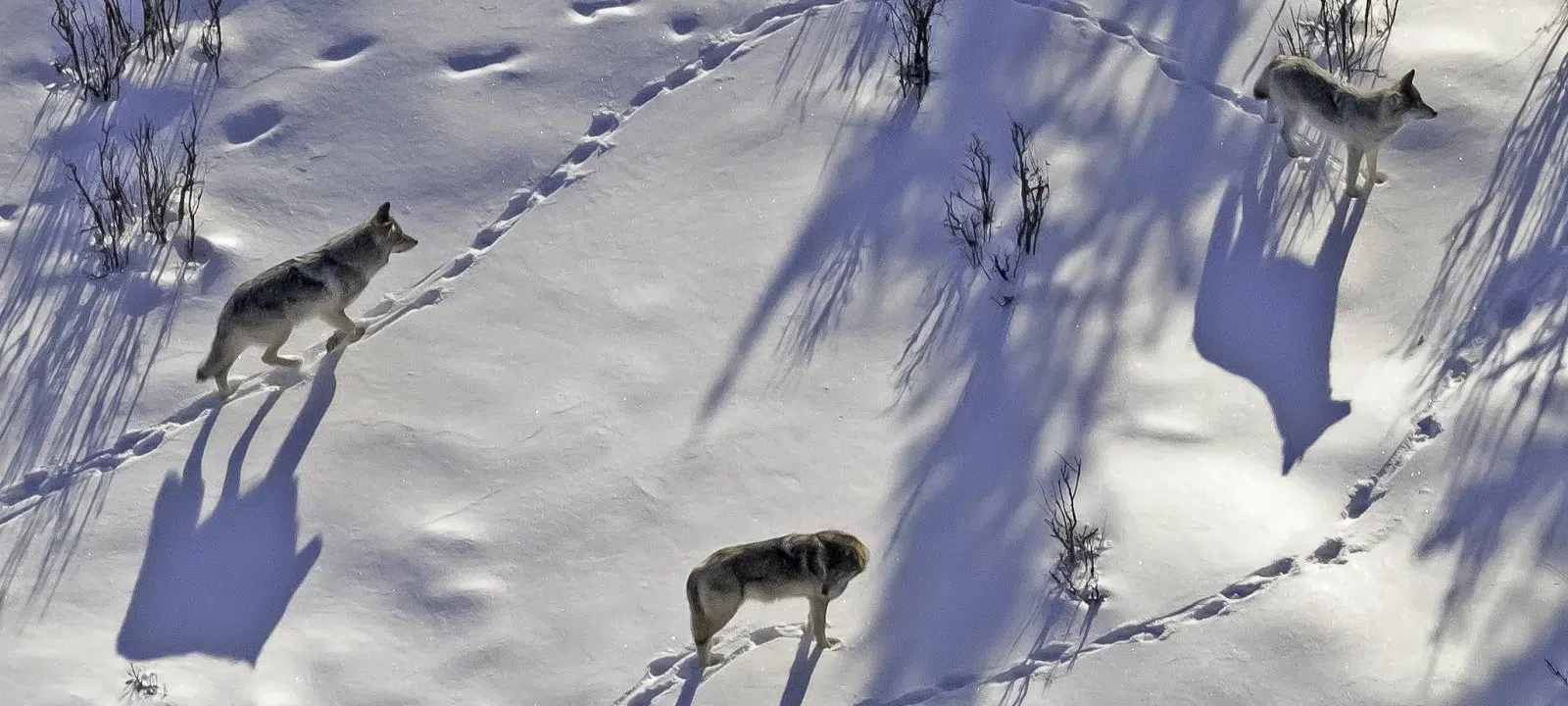
(Michigan Tech photo)
Wolves, their count up by three, stabilize and organize.
Moose, down by 379, starve and decline. Michigan Technological University researchers discuss the latest populations in the 64th Isle Royale Winter Study.
The annual winter study, led by Sarah Hoy, John Vucetich and Rolf Peterson of Michigan Tech’s College of Forest Resources and Environmental Science (CFRES), is the longest-running predator-prey study in the world — now in its 65th year. As always, fieldwork for the winter study of wolves and moose was conducted during a seven-week expedition at Isle Royale National Park.
This year, MTU researchers visited the island from Jan. 20 to March 3. They found a stabilized wolf population with a dynamic, somewhat unexpected social organization that includes lone wolves and small groups outside established packs. They also observed a moose population in dramatic but not unprecedented decline, succumbing to starvation due to a food shortage.
Wolves are thriving, according to the research team. Isle Royale’s wolf population is likely 31, including the East Pack with 11 wolves and the West Pack with five wolves, both established since 2019-20. Researchers also observed a small pack formed in the middle of the island — a deviation from the social organization seen over the last few years.
“Prior to the translocation of wolves to Isle Royale in 2018, the wolf population most commonly consisted of three stable packs and a small number of lone wolves,” Vucetich explained. “By contrast, over the past 12 months the population appears to be characterized by three to four reproducing groups, of which only two seem to have well-established territories, and many wolves that are not closely associated with an established pack.”
Most of the wolf pups born on the island last year belonged to the established packs. Peterson said three or possibly four litters were born in spring 2022: one at the west end of the island, two at the east end and another probable litter in the middle. Both the East Pack and West Pack had three pups survive the winter, and more pups are expected to be born in 2023. “During the 2023 breeding season, we observed evidence of four, possibly five, breeding females,” said Peterson.
The uptick is a promising development for re-establishing a healthy wolf population. There were no litters observed on the island from 2015-18 — the island’s wolf population had collapsed due to inbreeding. After new wolves were brought to Isle Royale in 2018, there was one litter born in 2019, two litters born in both 2020 and 2021, and potentially four litters in 2022.
The number of moose killed by wolves, another indicator of wolf population health, tallied 26 during the winter study period. That’s slightly lower than the previous year, but in line with what researchers expected given the number of wolves and moose currently on the island, Hoy said.
















Comments