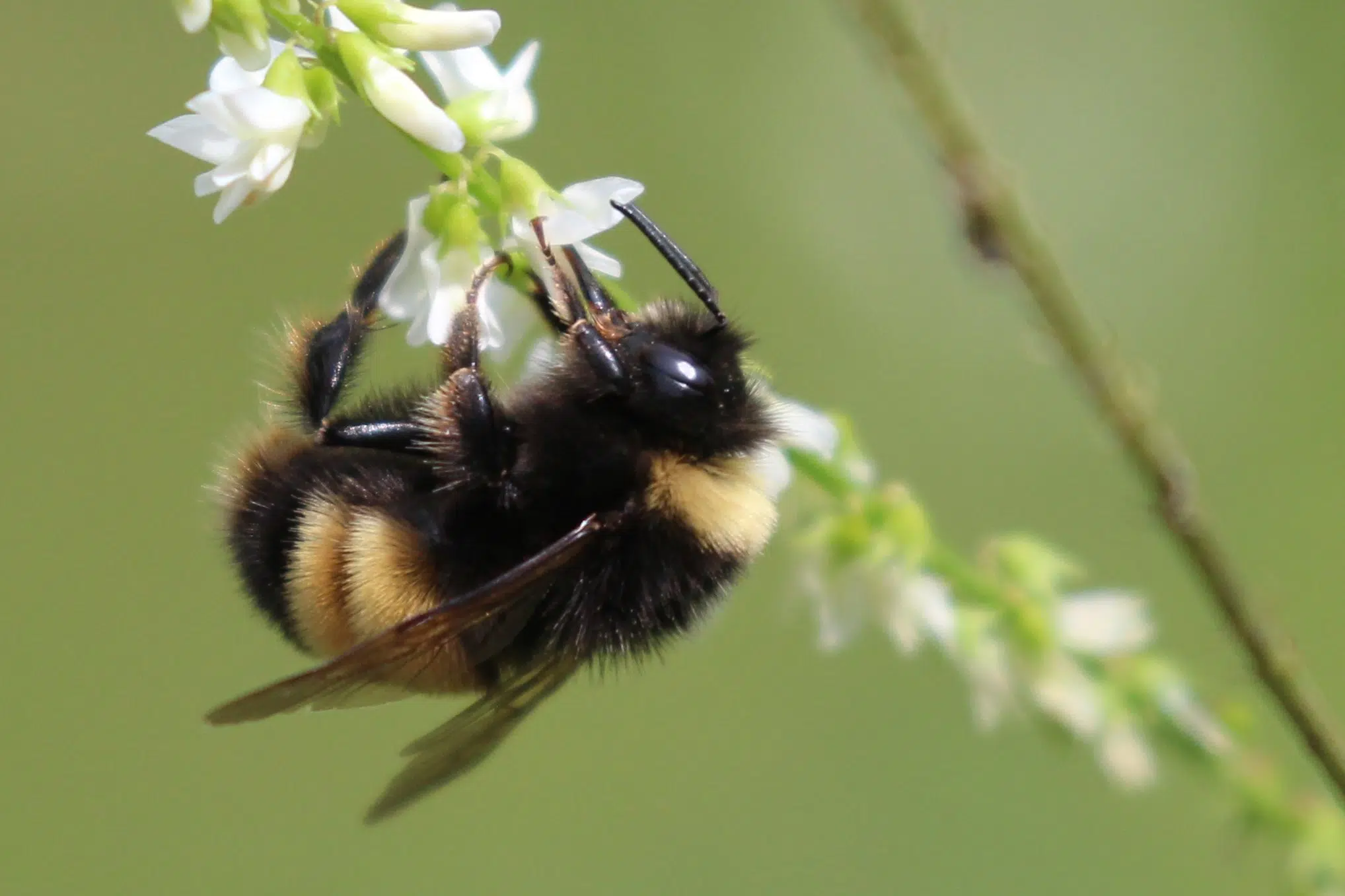
The declining abundance of insect and other animal pollinators in many ecosystems worldwide has been recorded since the end of the 20th century. Scientists are worried about rapid population decreases among important pollinators across the Midwest. Thanks to funding from the Great Lakes Restoration Initiative, Hiawatha National Forest will be involved in two efforts to reduce that decline: a tech savvy pollinator study led by the U.S. Forest Service Northern Research Station, and habitat improvement effort.
Dr. David King of the U.S. Forest Service Northern Research Station is collaborating with Forest Service botanists to identify the bees occurring in the Great Lakes Region and to understand the management needed for their conservation. This year, Dr. King’s research will take an exciting technological turn.
Dr. King says, “We have been working with Dr. Jeremy Andersen at UMass to develop an eDNA sampling protocol for bees. This year, we’ll put it into action.”
DNA (short for deoxyribonucleic acid) is the hereditary material in organisms that contains the biological instructions for building and maintaining a particular species. Environmental DNA (eDNA) is DNA released by an organism into the environment through feces, mucous, shed skin, and other means. This spring and summer, eDNA will be gathered by Hiawatha National Forest botanists. Then Drs. King and Andersen will use the eDNA to identify the diversity and abundance of bees on the Hiawatha National Forest. Similar collections of eDNA will be made on the Finger Lakes, Huron-Manistee, Ottawa, Chequamegon-Nicolet, and Superior National Forests.
Dave Cuthrell is a Conservation Scientist for Michigan Natural Features Inventory. Dave and his staff have been scouring the Upper Peninsula for the rare yellow-banded bumble bee (Bombus terricola) since 2013.
“We have a pretty good idea of yellow-banded bumble bee worker concentration areas within both the East and West zones of the Hiawatha, but we have a poor understanding of where the bumble bees actually nest,” said Cuthrell.
He added that knowing nesting locations would help scientists and land managers understand the specific habitat requirements for successful nests, which has significant implications for the conservation of the species. In 2013, as a first step toward understanding bumble bee communities in the Hiawatha, Cuthrell’s team counted foraging worker bumble bees on the Hiawatha.
“But other researchers discovered that for bumble bees the effective population size is the number of breeding pair colonies rather than the number of individuals. This means population estimates should be based on nest densities, rather than counting foraging workers,” said Cuthrell.
In order to identify and gather data about nest colonies, Paul Thompson, terrestrial ecologist for the Hiawatha, invited Cuthrell, fellow scientist Logan Rowe, and Michigan Natural Features Inventory staff to come back to the Hiawatha to document nest seeking B. terricola queens in early spring and follow them to nests.
“We will also document any foraging resources visited by queens during this time period, which is another important factor in conservation,” said Susan Trull, Ecologist for the Ottawa National Forest. Trull has asked Dave to conduct similar surveys on the Ottawa to gain insight for conservation of yellow-banded bumble bees on the west side of the Upper Peninsula as well.
The GLRI-funded project also includes efforts to enhance pollinator habitat on the Hiawatha. Forest Service botanists John Dollard and Robert Liebermann will plant species to improve nectaring opportunities for bees and along migratory pathways for monarch butterflies.
“Approximately 15 acres will be planted in 2022, half on the East Zone and half on the West Zone of the Hiawatha. This is a part of larger effort to enhance habitat for monarch butterflies and bumble bees and create connecting corridors across the landscape,” said Paul Thompson.
Why are pollinators like the bumble bee important?
“Pollinators carry pollen from the male part of a flower (stamen) to the female part of the same or another flower (pistil). The movement of pollen is required to produce fruits, seeds, and young plants,” said Thompson. Pollination is a key link in the lifecycle of the plants that sustain us.
Using GLRI funds, the collaborative team hopes to contribute to knowledge about and conservation of these important Great Lakes pollinators.
















Comments