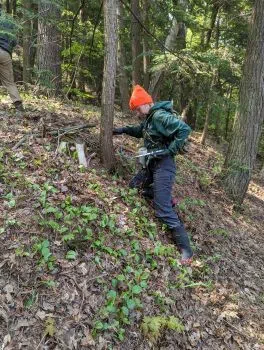
The state of Michigan today announced that 27 projects will share $2.4 million in funding through the Michigan Invasive Species Grant Program for efforts that address the prevention, detection, eradication and control of aquatic (water-based) and terrestrial (land-based) invasive species. To date, over $42 million has been awarded to support 328 projects undertaken by units of government, nonprofit organizations and institutions.
The program – cooperatively implemented by the Michigan departments of Agriculture and Rural Development; Environment, Great Lakes, and Energy; and Natural Resources – has four key objectives:
- Preventing the introduction of new invasive species.
- Strengthening the statewide invasives pecies early detection and response network.
- Limiting the spread of recently confirmed invasive species.
- Managing and controlling widespread, established invasive species.
This year, grants will support each of Michigan’s 22 regional cooperative invasive species management areas, the network of partnership organizations working to manage and control invasive species, actively serving all 83 counties in the state.
Each CISMA will receive $70,000 in annual support to provide education and technical assistance to landowners. Twelve CISMAs will receive additional funds for survey and treatment of high-priority invasive species including red swamp crayfish, water-primrose, wild parsnip, black swallowwort, knotweeds and kudzu. Grants to CISMAs represent $1.7 million in this cycle.
|
Chippewa Luce Mackinac Conservation District |
Three Shores CISMA 2026 Core Funding |
The “Three Shores CISMA 2025 Core Funding” will carry out the objectives of the Three Shores CISMA Strategic Plan by providing a network of invasive species leadership, expertise, professional management, and outreach to Michigan’s Eastern Upper Peninsula. |
Chippewa, Luce, Mackinac counties |
$70,000 |
|
Marquette County Conservation District |
Support for Essential Functions of L2L CISMA |
This funding will support the internal and essential functions of L2L CISMA including Coordinator support, outreach and education, and essential survey and treatment efforts. |
Alger, Delta, Marquette, Schoolcraft counties |
$90,000 |
|
Dickinson Conservation District |
Pursuing Sustainable CISMA Structure – Non-Profit Transition and Maintaining Key Programs |
To improve organizational adaptability, Wild Rivers Invasive Species Coalition is transitioning from a fiscal partnership to a 501(c)3 nonprofit. This funding will support transition & enable the new organization, Roots & Rivers Collaborative, to establish smoothly while remaining mission focused. |
Dickinson, Menominee counties |
$70,000 |
|
Iron Baraga Conservation District |
WePIC CWMA: PICing Away Invasive Species with the MISGP |
Our focus is on managing and preventing invasive species in West UP, particularly AIS. We implement strategies for early detection and rapid response while building partnerships, engaging volunteers, and diversifying funding sources to ensure long-term success despite funding challenges. |
Iron, Gogebic, Ontonagon counties |
$70,000 |
|
Michigan Technological University |
Protecting natural areas through KISMA core activities and prioritized survey and treatment |
The Keweenaw Invasive Species Management Area (KISMA) is expanding services with multi-source funding that will provide opportunities for terrestrial and aquatic invasive species outreach, surveying, treatment, and monitoring across Baraga, Houghton, and Keweenaw counties. |
Baraga, Houghton, Keweenaw counties |
$70,000 |














Comments