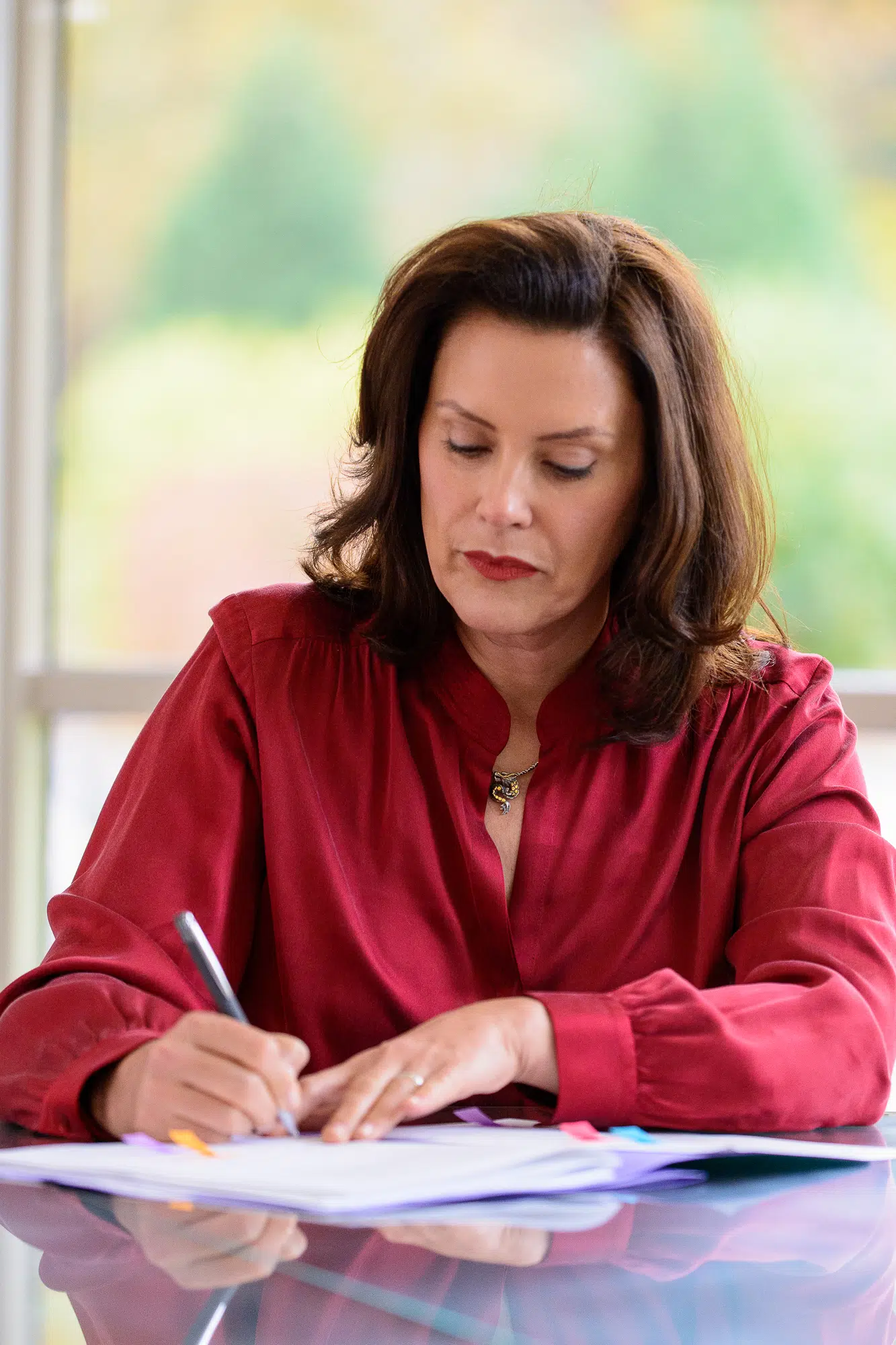
Today Governor Gretchen Whitmer signed legislation that supports the COVID-19 recovery plan she sent to the legislature in January. It includes key provisions of the governor’s MI COVID Recovery Plan, including a $2.25/hour wage increase for direct care workers, $283 million in federal emergency rental assistance to help ensure people can stay in their homes, up to $110 million in federal funding for vaccine administration, and up to $555 million in federal funding for testing and tracing.
Whitmer also vetoed large portions of the legislation because Republicans tied allocating the federal money to her giving up some of her powers to impose restrictions on businesses and schools. The GOP proposal would have many of those decisions be made by local health departments, and set benchmarks that would have to be met before locals could impose restrictions or close schools or cancel sporting events.
“Unfortunately, the legislature tried to prohibit expenditure of funds for vaccine distribution and the return to school unless the governor signs legislation stripping powers from the executive branch. Rather than these political games, we need to focus instead on how to best help businesses and individuals most impacted by the pandemic,” said Budget Director David Massaron. “Vetoes were necessary and now we need to collectively refocus efforts on the best way to get resources out the door to speed our recovery from the pandemic. I again encourage the chairs of the appropriations committees to accept my offer to get in a room and figure out how we can effectively align our resources with the need.”
Republicans fired back, saying that the governor is turning her back on people who have been hurt by restrictions she has imposed.
“One year after the first case of COVID-19 was detected in Michigan, Gov. Whitmer is sending a clear message to the people of our state – she doesn’t care about you or if your livelihood survives the pandemic. If she cared about anything other than preserving her own self-declared power, she would not have vetoed so much of the Legislature’s $4.2 billion relief plan,” said House Appropriations Committee Chairman Thomas Albert (R-Lowell). “Thousands of Michiganders have already lost their jobs as the restaurants and other small businesses they worked at closed their doors forever because of COVID and the governor’s strictest-in-the-nation pandemic measures. Thousands more are hanging on by a thread, and they were counting on the afflicted business survival program and support related to the unemployment system to help make it through. This desperately needed assistance was not tied to any other measure or condition in the relief plan – yet the governor vetoed it anyway, and with it, she is killing off whatever hope struggling families and job providers had left.”
Whitmer says she is happy to get much of the funding into the COIVID-19 battle, funding that was not tied to her accepting reduced control of pandemic management.
“I think it’s great news that we’ve been able to get some of the federal funding available to us appropriated, including passing two of my key proposals to provide a wage increase for direct care workers and increased funding to help expand vaccinations for Michiganders who are 50 years old or older,” said Governor Whitmer. “However, the reality is that there is more work to be done and there are still billions of dollars in federal funding that we need to get out the door to help businesses and families across the state. The bills I received were not negotiated with me or my administration, and I continue to call on the legislature to ensure that we work together to ensure we maximize every penny that is available. There were problems in the bills that I had to veto, and I expect the legislature to step up to fix the bill to allocate all of the money so we can get back to normal as soon as possible.”
State Budget Director David Massaron also sent a letter to the appropriations chairs in the House and Senate, asking again for a joint meeting no later than Friday, March 12 where formal negotiations can occur, with the goal of getting the remaining more than $2 billion in federal funding appropriated. In the letter, Director Massaron shares his desire to provide meaningful help to businesses impacted by the pandemic.
“We are on a good path to recovery and our key metrics and numbers are improving, but we need to put the rest of the available federal funding to work, much of it aimed at helping businesses and aiding their recovery,” added Governor Whitmer. “The light at the end of the tunnel is getting brighter and I thank every Michigander who has done their part in the response to the pandemic.”
As part of the MI COVID Recovery Plan, Governor Whitmer proposed $665 million to expand the state’s vaccine and testing programs, and $2.1 billion for schools. Unfortunately, the legislature inserted boilerplate that aims to block expenditure of these funds unless the governor signs separate legislation undercutting Michigan’s pandemic response. The governor has called on the legislature to return to the table to fully appropriate the more than $2 billion in unused federal funds.
Governor Whitmer proposed fully allocating $622 million for rent and utility assistance, but the legislature only provided $283 million – withholding $339 million that was meant to keep families safely in their homes and provide direct aid to landlords. The COVID Emergency Rental Assistance (CERA) program replaces the popular Eviction Diversion Program (EDP) MSHDA launched in July 2020, which helped approximately 16,000 households across the state avoid eviction and get current on owed rent. MSHDA will administer CERA through its statewide network of Housing Assessment and Resource Agencies (HARAs), which will be responsible for working directly with tenants and landlords so that the rental arrearages are paid and housing stability is preserved. For more information, visit Michigan.gov/CERA.
Governor Whitmer also proposed fully allocating $2.7 billion to help residents feed their families, but the legislature only provided $600 million – withholding $2.1 billion in food assistance through the federal Supplemental Nutrition Assistance Program (SNAP). Michiganders can apply for food assistance by going online to www.michigan.gov/MIBridges.
In a transmittal letter, Governor Whitmer observed that the 48-day delay since the release of her COVID Recovery Plan necessitated immediate signature of the supplemental funding bill, but that legal review of budget boilerplate was ongoing. When the legal review of this bill’s budget boilerplate is completed, the governor will direct state departments to implement this legislation consistent with constitutional requirements. Governor Whitmer also disapproved two items in each bill, pursuant to article 5, section 19 of the Michigan Constitution of 1963.
For his part, Committee Chairman Albert says Republicans will keep working on getting through the pandemic, and getting back to normal life.
“Overall this relief plan is not exactly what the governor wants or what the Legislature wants, but it’s what the people of Michigan need,” Albert said. “I am deeply disappointed the governor has vetoed so much of it, but not surprised. The governor’s history of putting her own political ambitions ahead of the people she was elected to serve began well before this pandemic. This is the same governor, after all, who vetoed support for children with autism, senior citizens and law enforcement in 2019. Today was just the latest example of her misguided priorities – and thousands of Michigan families will suffer because of it.”
















Comments